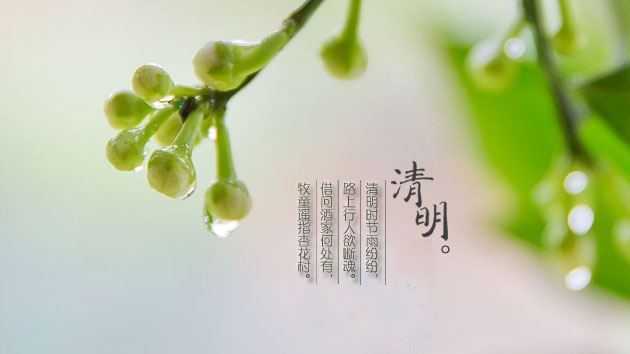
Pure Brightness(清明) is the 5th of the 24 solar terms, marking a key period in mid-to-late spring. It arrives when the sun reaches the celestial longitude of 15°. The name originates from the phrase “Qi Qing Jing Ming,” describing a time when the air is crisp and the scenery is bright, making everything in nature clearly visible. As a solar term reflecting phenological changes, it characterizes a season of radiant sunshine, budding plants, and blooming flowers—a true portrait of vitality. In southern China, this clarity is already in full display, while northern regions see the last of the snow as temperatures rise and the warmth of spring takes hold.
Qingming is unique for its dual nature, serving as both a natural solar term and a traditional festival. Falling between April 4th and 6th (most commonly April 5th), it marks the transition from mid to late spring. The core customs revolve around ancestor worship (tomb-sweeping) and spring outings (Taqing), with commemorative activities typically spanning from 10 days before to 8 days after the day itself. It is a time for nature to “breathe out the old and take in the new.” In modern times, these traditions have evolved to include low-carbon practices like online tributes and memorial tree planting.
Rooted in ancient agrarian civilization and ancestral rites, the festival’s identity was shaped by merging customs from the Cold Food Festival and Shangsi Festival. Historically calculated using the gnomon shadow method, its timing has been determined by celestial longitude since 1645. Recognized as a National Intangible Cultural Heritage in 2006, its importance to farming is captured in the popular proverb: “Around Qingming, plant your melons and beans,” highlighting its enduring role as a guide for agricultural production.
Phenological Phenomena
When the Big Dipper’s handle points toward the celestial position of Yi, the Qingming wind—a breeze characterized by its crispness and purity—begins to blow. Arriving fifteen days after the Spring Equinox, Qingming is a time when all things in nature appear clean, orderly, and bright. It is a season defined by “clear air and radiant scenery,” where every element of the natural world stands out in sharp detail. As a solar term reflecting phenology, Qingming signifies bright, sunny days and the lush, flourishing growth of vegetation.
Ancient Chinese literature divides Qingming into three pentads (five-day periods):
- The first pentad: The Paulownia begins to bloom (Tong shi hua).
- The second pentad: Field mice disappear as quails start to appear (Tianshu hua wei ru).
- The third pentad: Rainbows begin to grace the sky (Hong shi jian).
Accompanying these periods are the “Flower Signals” (Hua Xin Feng). The first signal is the Paulownia flower, followed by the Wheat flower, and finally the Willow flower. The wheat flower, representing the second pentad, is often described as “fine and delicate” or a “vast expanse of snowy light.” Despite its beauty, it is known as one of the shortest-lived blooms in nature.
The blooming of willow flowers often evokes a deep sense of nostalgia and longing for loved ones. Traditionally, people celebrate this time by wearing or planting willow branches and even consuming tender willow sprouts. Throughout history, poets and scholars have celebrated the willow in their works, often breaking a willow twig as a parting gift to express their deep reluctance to say goodbye.
Traditional Customs
Tomb-Sweeping and Ancestral Rites
The Qingming Festival is an ancient Chinese tradition that balances the solemnity of ancestral worship with the joy of reconnecting with nature through spring outings. Known as muji (tomb sacrifice), tomb-sweeping is an expression of “timely respect” for one’s ancestors—a long-standing practice of remembrance. The festival seamlessly integrates natural solar terms with human customs, embodying the ancient Chinese pursuit of harmony between Heaven, Earth, and Humanity, as well as the wisdom of living in sync with natural cycles.
In many parts of Southern China, such as Fujian, Guangdong, Hainan, Guangxi, and Kunming, tomb-sweeping also occurs during the Double Ninth Festival or the Winter Solstice. Beyond the “hillside rites” at gravesites, later generations developed ancestral hall rites (miaoji), which trace their lineage back to ancient spring sacrificial ceremonies. While separated by millennia, they share the same cultural DNA, serving as communal gatherings for the entire clan. While these customs predated the Qin dynasty, regional practices varied; in the North, rites were primarily held during the Cold Food and Hanyi festivals until the Tang and Song dynasties, when Qingming became the nationwide standard for ancestral veneration.
The essence of the Qingming ritual is to honor ancestors, demonstrating filial piety and deep longing for those who have passed. It is a cultural cornerstone of “observing the funeral rites of parents and following them when gone with due sacrifices” (Shen Zhong Zhui Yuan). The ritual window is broad, typically spanning from 10 days before to 8 days after the actual festival day, and extending up to a month in some regions. Traditionally, families bring food, wine, fruit, and joss paper to the gravesite. They offer food to the deceased, burn the ritual paper, add fresh soil to the mound, and plant green willow branches before performing ritual prostrations (kowtowing).
Today, the Ministry of Civil Affairs actively promotes eco-friendly alternatives such as flower offerings, online tributes, and community memorial services. Local authorities are encouraged to organize patriotic and revolutionary education programs to honor fallen heroes. These efforts aim to advocate for modern funeral concepts, guiding the public away from outdated superstitions toward more civilized and sustainable ways of mourning.
Spring Outing (Taqing)
With the radiant sunshine and lush greenery of the season, Qingming is the perfect time for a spring excursion. Known as Taqing (treading on the green), and historically referred to as “searching for spring,” this tradition often goes hand-in-hand with ancestral rites. Since tomb-sweeping usually takes place in the countryside, people naturally combine paying their respects with a refreshing walk in nature. This blend of honoring the past while rejuvenating the mind and body has made spring outings a hallmark of the festival.
Kite Flying
Flying kites is another beloved activity during the Qingming period, enjoyed both day and night. After dark, strings of tiny colored lanterns are attached to the kites or their lines, twinkling like stars in the sky—a sight known as “God’s Lanterns.” In the past, some would cut the string once the kite was high in the air, letting the breeze carry it away to the horizon. This was believed to ward off illness and misfortune, bringing good luck to the flier.
Eating Qingtuan (Green Rice Balls)
In the Jiangnan region (the lower reaches of the Yangtze River), eating Qingtuan is a quintessential Qingming custom. These vibrant green treats are made by crushing wild “barley grass” to extract its juice, which is then kneaded into dried glutinous rice flour. The filling typically consists of smooth, sweet red bean paste and a small piece of lard for richness. Once steamed, the balls are brushed with vegetable oil, giving them a jade-like luster. Soft, chewy, and fragrant, Qingtuan are sweet without being cloying. Beyond being a seasonal delicacy, they are an essential offering for ancestral sacrifices, holding a special place in the culinary heritage of Southern China.
Eating Sanzi (Fried Dough Twists)
The custom of eating Sanzi during the Qingming Festival is shared across both Northern and Southern China. Sanzi is a delicate, crispy fried snack, known in ancient times as hanju (cold food). While the tradition of forbidding fire and eating only cold meals during the Cold Food Festival has largely faded, Sanzi remains a beloved treat. Today, regional variations persist: Northern Sanzi tends to be bold and hearty, primarily made from wheat flour, whereas Southern Sanzi is intricate and refined, often using rice flour as the main ingredient.
Savoring River Snails
Qingming marks the prime season for harvesting and eating river snails. Since they haven’t yet entered their breeding cycle, the snails are at their plumpest and most succulent, leading to the popular folk saying: “A Qingming snail is as meaty as a whole goose.” There are countless ways to prepare them—they can be stir-fried with scallions, ginger, soy sauce, rice wine, and sugar, or boiled so the meat can be extracted. Whether tossed in a dressing, marinated in liquor, or quickly blanched, they are consistently delicious. When prepared just right, they truly live up to the praise: “A single snail offers a thousand delights, surpassing even the finest gourmet dishes and wines.”
Other Delicacies
In addition, various regions across China celebrate Qingming with a rich array of nutritious local specialties. These include eggs, cakes, sandwich cookies, and seasonal treats such as Qingming Zongzi (sticky rice dumplings), Qingming Guo (rice cakes), Mo-ci (pounded rice cakes), and “dry porridge.” Each reflects the diverse culinary heritage and the celebratory spirit of the season.
Health and Well-being
Regarding health preservation during Qingming, the ancient medical text Huangdi Neijing (The Inner Canon of the Yellow Emperor) provides clear guidance in the chapter “Treatise on Regulating the Spirit Conforming to the Four Seasons.” Spring is a time of rejuvenation. To align with the natural rise of Yang energy, one should go to bed a bit later and rise earlier, allowing the body to relax and the mind to stay refreshed and at ease in harmony with the spring air. This is the natural law of health; defying it can harm the liver. During this period, one should embrace the expansive and fluid nature of spring vitality, protecting and nurturing the body’s internal Yang energy while avoiding anything that might deplete or obstruct it.
Dietary Recommendations
In terms of diet, it is advisable to choose mild, nourishing foods—increasing sweet flavors while reducing sour ones—to warm the Yang energy and balance the liver and digestive system. Since liver energy is at its peak in spring, excessive sour food can overstimulate the liver and interfere with digestion. Those with a weak spleen or stomach should limit cold or raw foods to ensure the rising Yang energy isn’t suppressed. Chrysanthemum tea is highly recommended; it dispels wind-heat, clears the lungs, and brightens the eyes. Drinking it not only supports the liver and gallbladder but also helps release the “cold pathogens” accumulated in the body during winter.
Daily Routine and Outings
As the weather warms up around Qingming, bacteria and viruses thrive, making it a peak season for respiratory infections and gastrointestinal issues. When heading out, be mindful of your clothing—“neither too cold nor too hot”—to adapt to fluctuating temperatures. It is important to maintain healthy habits such as wearing masks, frequent handwashing, ensuring good ventilation, and practicing social distancing to prevent “illness from entering through the mouth.” If you feel unwell, seek medical attention promptly.