04 Epilogue
For a civilization, what exactly do gods signify? Perhaps, what we call “deities” was, in reality, merely a means by which the ancients—lost and bewildered—sought to comprehend the world and explain the myriad phenomena of the universe.
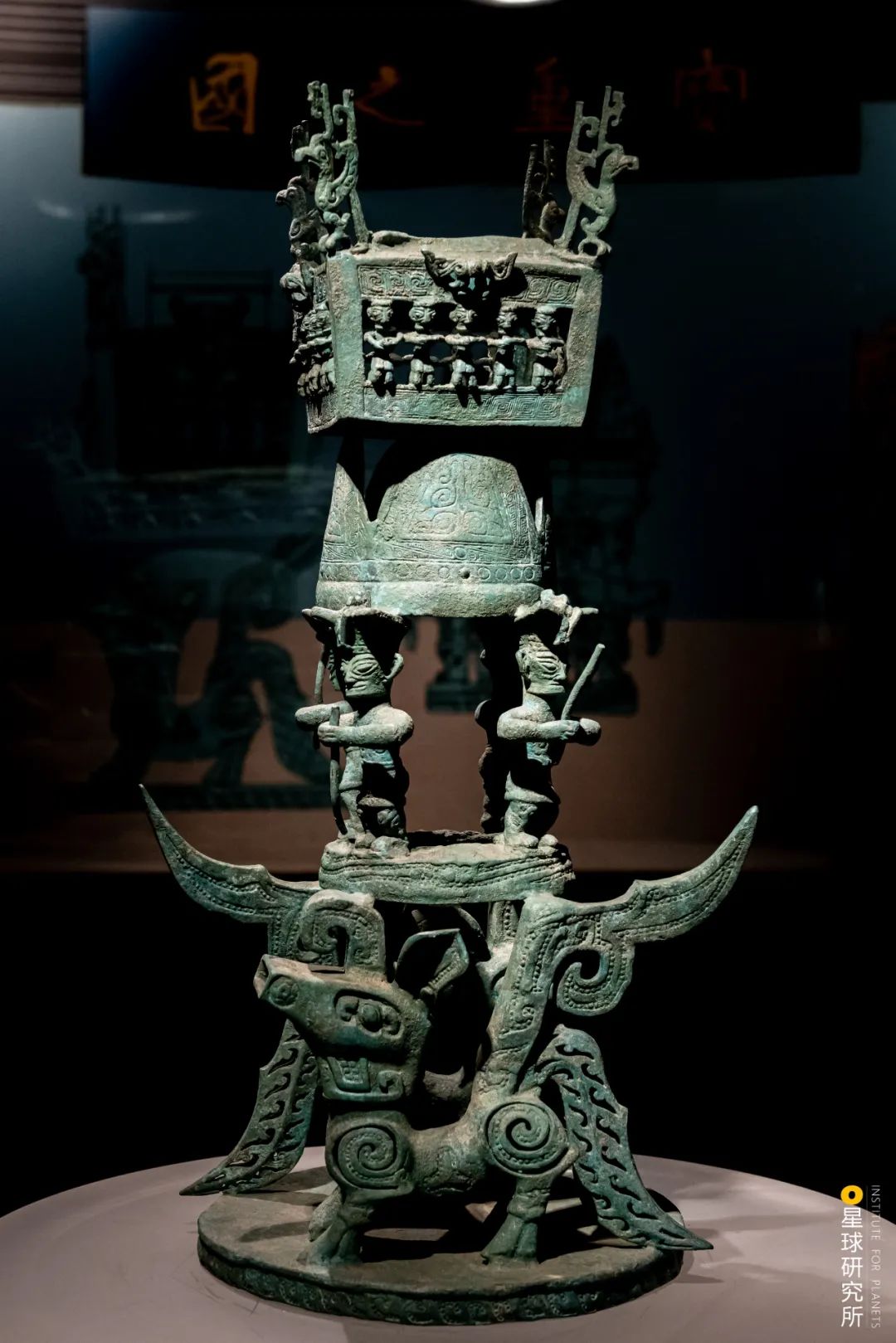
(The Sanxingdui Bronze Altar [Research-based Reconstruction]: Arranged from top to bottom, its tiers symbolize the “Three Realms”—Heaven, Man, and Earth—as envisioned by the ancient Shu people. Photographer: @Bao Haolin)
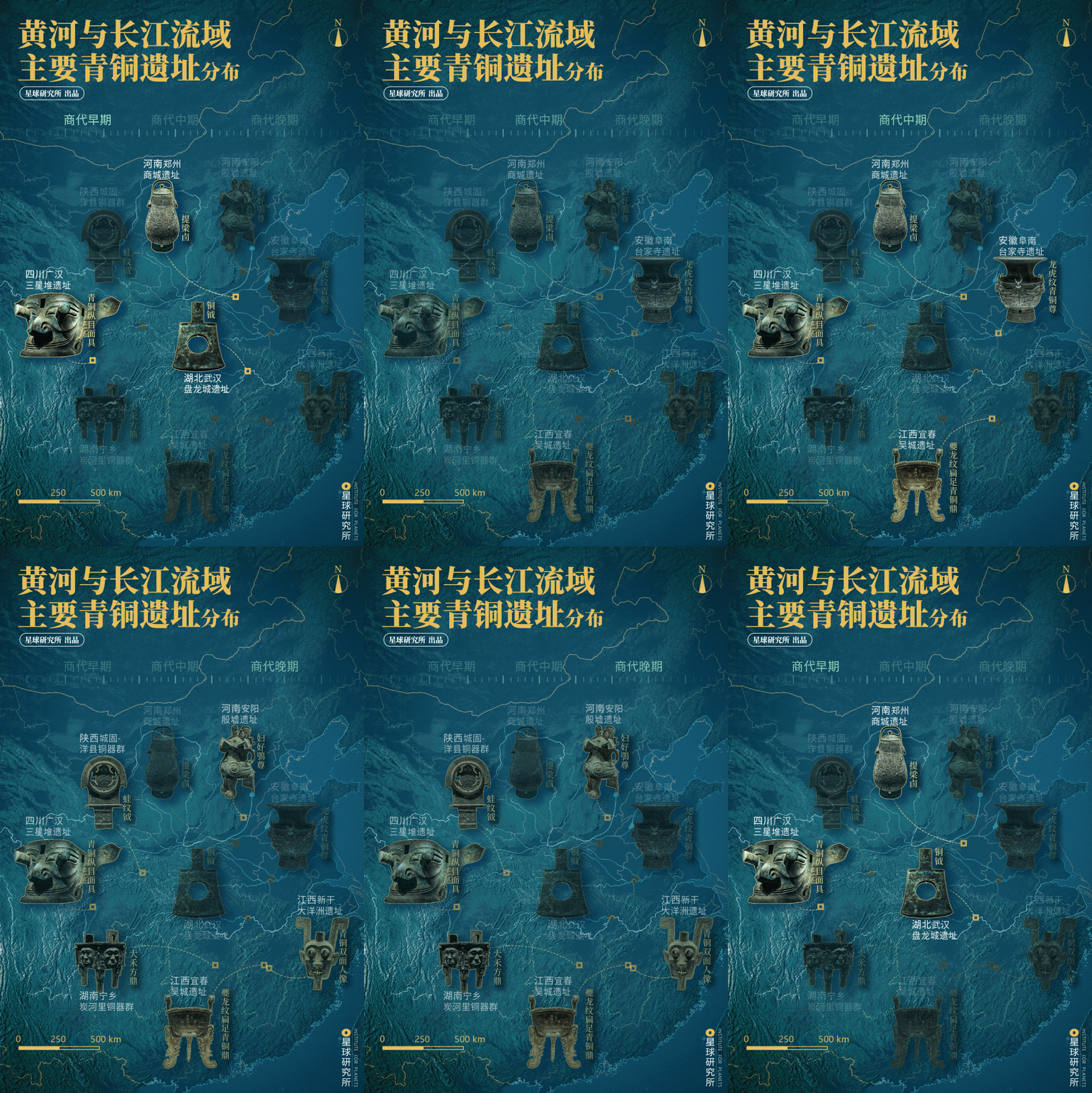
In the early history of China, countless models of civilization were being explored simultaneously. Some were pragmatic, others extravagant; some excelled in cultural sophistication, others in agricultural prowess. These myriad explorations were akin to striking match after match in the darkness—each flaring briefly into light, only to be extinguished once more.
(Multiple brilliant Bronze Age civilizations once flourished within the basins of the Yellow River and the Yangtze River. Photographers: @Sun Yan, @Liu Peng, @Jiao Xiaoxiang, @Jian Shu, @Liu Yeda, @Kang Ziji, @Feng Sixu, @Fan Xiaozhe, @Tang Yuxing. Cartography: @Chen Zhihao / Planet Institute)
Sanxingdui rose for the sake of the divine…
And for the sake of the divine, it vanished.
Leaving behind nothing but a succession of mysteries,
Awaiting resolution by generations to come.
Yet, whatever the ultimate answer may be,
The world will surely come to know:
That upon this very land—in what is now southwestern China—
Behind the mists of mystery and legend,
There once shone forth…
A light of civilization of unparalleled brilliance.
Production Team
Writing: Huang Taiji
Editing: Suozhang
Photography: Zhang Zhaohai
Cartography: Chen Zhihao
Design: Feng Yizhuo, Wang Shenwen, Zhao Bang
Animation: Xiao Tong, Song Zhipeng
Cover Photography: Yu Jia
Proofreading & Fact-checking: Su Nan, Tingting, Zheng Yi
Expert Reviewer
Director, Sanxingdui Archaeological Research Institute, Sichuan Provincial Institute of Cultural Relics and Archaeology; Alumnus (Class of 2006), School of Archaeology and Museology, Peking University. Ran Honglin Director, Sanxingdui Site Workstation, Sichuan Provincial Institute of Cultural Relics and Archaeology; Peking University Archaeology Alumnus (Class of 1980) | Lei Yu
Notes:
There are various terminologies regarding the pits containing ritual artifacts at Sanxingdui—such as “sacrificial pits” or “artifact pits.” This article adopts a more neutral designation, collectively referring to them as the “Sanxingdui Buried Pits.”
Current research concerning Sanxingdui remains a subject of considerable debate; this article presents only a selection of the prevailing viewpoints.
The nomenclature used for cultural relics throughout this text follows, as a standard reference, the exhibition information provided by the Sanxingdui Museum.
Regarding the reasons behind the creation of deities at Sanxingdui—discussed at the conclusion of Chapter 1—no definitive consensus has yet been reached; the assertions presented herein remain speculative.
For illustrative purposes, the maps featured in this text depict the hydrological systems and land-sea configurations characteristic of the Shang and Zhou dynasties. [References]
[1] Sichuan Provincial Institute of Cultural Relics and Archaeology. The Sanxingdui Sacrificial Pits [M]. Cultural Relics Publishing House, 1999.
[2] Chengdu Institute of Cultural Relics and Archaeology; Chengdu Jinsha Site Museum. Collected Archaeological Excavation Data of the Jinsha Site [M]. Science Press, 2013.
[3] Li Ling et al. Magnificent Archaeological Sites: Traversing History with Frontline Archaeology Team Leaders [M]. SDX Joint Publishing Company, 2020.
[4] Xue Peng, Ai Jiangtao. In Search of Sanxingdui: Exploring the Bronze Civilization of the Yangtze River Basin [M]. SDX Joint Publishing Company, 2021.
[5] Duan Yu. Discovering Sanxingdui [M]. Zhonghua Book Company, 2021.
[6] Huang Jianhua. From Sanxingdui to Jinsha: Astonishing Discoveries of Chinese Civilization [M]. Zhonghua Book Company, 2021.
[7] Sanxingdui Museum, Guanghan, Sichuan. Encountering Sanxingdui [M]. Bashu Publishing House, 2022.
[8] Wang Renxiang. Sanxingdui: A Myth Cast in Bronze [M]. Bashu Publishing House, 2022.
[9] Archaeological Team for the Sacrificial Area of the Sanxingdui Site. “The Sacrificial Area of the Sanxingdui Site in Guanghan City, Sichuan” [J]. Archaeology, 2022(07).
[10] Liu Xingshi. “The Rise and Fall of Ancient City Clusters on the Chengdu Plain and Issues of Paleoclimate” [J]. Sichuan Cultural Relics, 1998(04).
[11] Tang Qicui. “Water and Cities: A Review of Research on Prehistoric Settlement Patterns on the Chengdu Plain” [J]. Huaxia Archaeology, 2012(01).
[12] Zhao Dianzeng. “Research on the Theocratic Ancient State of Sanxingdui” [J]. Sichuan Cultural Relics, 2019(01).
[13] Wu Jiabi. “The ‘Deification’ of Ancient Shu and the Sanxingdui Sacrificial Pits” [J]. Sichuan Cultural Relics, 2021(01).
[14] Sun Hua, Li Wanxin. The Origin and Development of the Ancient Chinese Myth of the Sun Bird—A Discussion Based on Artifacts Related to Sun Worship in Ancient Shu Culture [J]. Southern Cultural Relics, 2022(01).
[15] Ran Honglin. A Preliminary Study of Sacrificial Remains in the Ancient Shu Region [J]. Sichuan Cultural Relics, 2022(06).
[16] Sun Hua. New Discoveries and Insights Regarding the Sacrificial Pits at Sanxingdui [J]. Archaeology, 2022(06).
Planet Institute
Exploring the world in its most extreme forms, through the lens of geography.
···THE END···